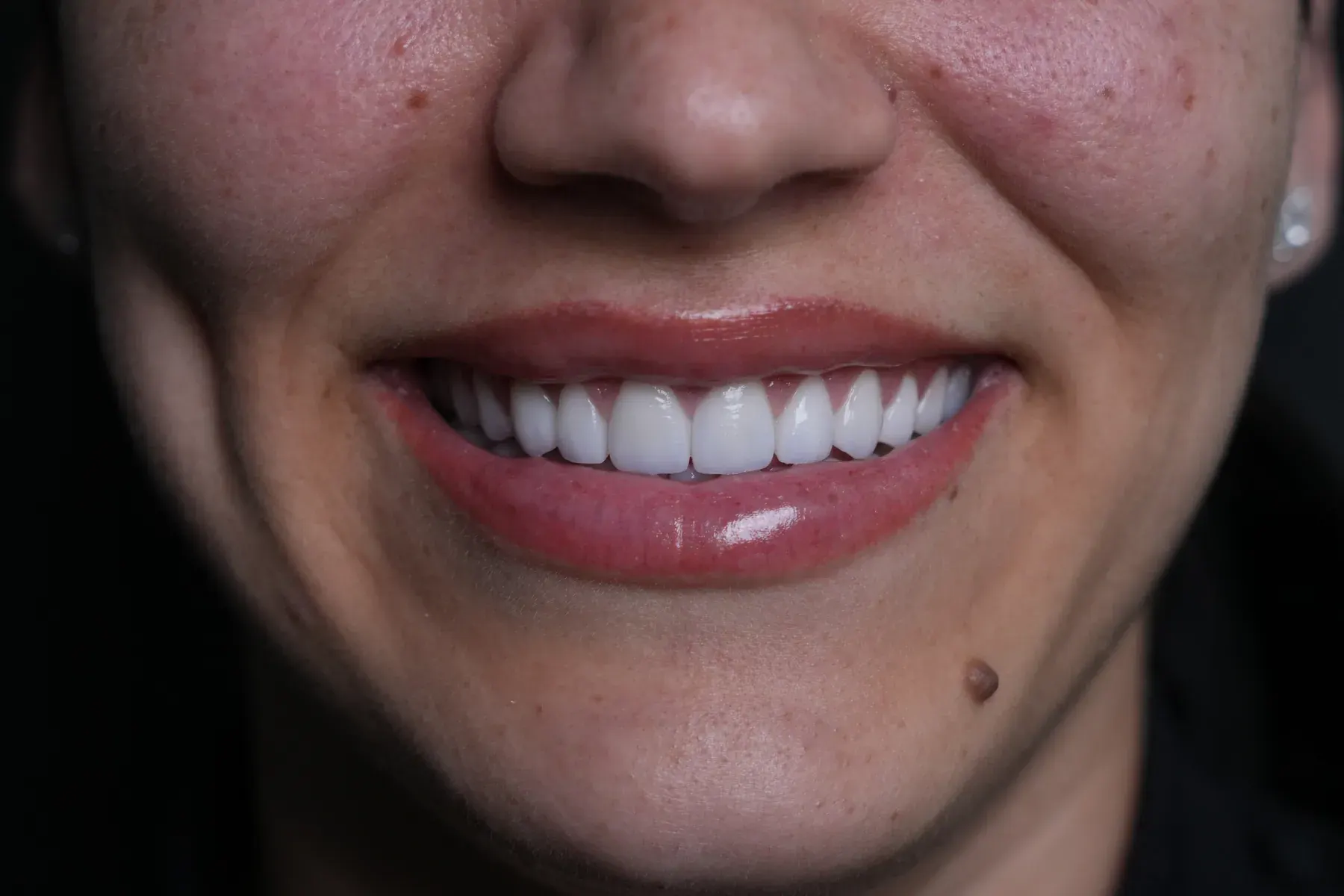
Yes, many people who grind or clench can get veneers, but it takes extra planning. Your dentist will check how much force your bite produces, design veneers that avoid the heaviest contact points, choose a suitable material and, in most cases, ask you to wear a night guard. Without those steps, grinding can chip or loosen veneers.
What grinding and clenching actually mean
- Bruxism: the medical name for grinding or clenching the teeth, usually without realizing it. It often happens during sleep, but some people also clench during the day, especially under stress or while concentrating.
- Grinding: moving the teeth side to side against each other.
- Clenching: pressing the teeth together hard, without moving them.
Both put far more force on the teeth than normal chewing, and for longer. Natural teeth show it over time; veneers feel it too.
Signs you might grind without knowing it
Many people learn they grind only when someone tells them. Common clues include:
- Waking up with a sore jaw, tight cheeks or a headache near the temples.
- Flat, short or chipped edges on the front teeth.
- Small cracks or worn spots on the back teeth.
- Tooth sensitivity with no obvious cavity.
- A partner who hears grinding at night.
- Scalloped marks on the sides of the tongue or a ridge on the inside of the cheek.
If several of these sound familiar, tell your dentist before planning veneers. It changes the plan.
Why grinding matters for veneers
Porcelain is strong and hard-wearing, but it is a ceramic: it handles pressure well and sudden sideways force less well. Heavy grinding can:
- Chip the edges of the veneers, especially the biting edges of the front teeth.
- Weaken the bond over time, so a veneer may come loose.
- Wear the opposing teeth, since porcelain is hard.
None of this means veneers are off the table. It means the plan has to account for your bite.
How a good plan protects veneers in a grinder
- Studying your bite first. Your dentist looks at how your upper and lower teeth meet and slide. Sometimes the bite itself needs adjustment, or the teeth need aligning first with Invisalign, to spread the forces better.
- Designing the shape around the bite. The length and the biting edge of each veneer are planned so the heaviest contacts land where porcelain can take them.
- Choosing the right material and thickness. Your dentist and ceramist choose the porcelain and its thickness for strength as well as beauty. Our page on veneer materials explains the options. In some cases a crown is a better choice for a tooth that takes heavy force; see veneers vs crowns.
- Testing with temporaries. At Art Dental Studio, after a digital preview, you wear provisional veneers in a "test drive" phase. That period is also a chance to see how the new shape behaves with your bite before the final veneers are made.
- A night guard. A custom-made guard worn while you sleep is usually the most important step. It absorbs the force so your veneers don't.
About night guards, in plain language
A night guard is a thin, custom-fitted plastic tray that covers your teeth while you sleep. It doesn't stop the habit, but it puts a cushion between the teeth so the force lands on the guard. Over-the-counter guards exist, but a custom guard made from your teeth tends to fit better and be more comfortable to wear every night — and a guard only helps if you wear it.
Clean it each morning with cool water and a soft brush, keep it in its case, and bring it to your checkups so it can be checked for fit and wear.
Bonding vs porcelain for grinders
| Composite bonding | Porcelain veneers | |
|---|---|---|
| If it chips | Usually easy to repair in the chair | Usually needs to be remade |
| Wear on opposite teeth | Gentler | Can be harder on opposing teeth if unpolished |
| Stain resistance | Lower | Higher |
| Fits best when | You want something easy to touch up | You want a long-term change, with a guard |
For some heavy grinders, bonding is a sensible first step, because repairs are simpler. Others do very well with porcelain and a consistent night guard. Read veneers vs bonding to compare.
Grinding, stress and the jaw joint
Grinding can be linked to stress, sleep problems or the bite. If you have jaw pain, clicking or trouble opening your mouth, mention it. Your dentist may suggest addressing those first, and sometimes other specialists are involved. A multi-specialty team under one roof makes it easier to coordinate.
Questions to ask at your consultation
- Do I show signs of grinding or clenching?
- Should my bite be adjusted or aligned before veneers?
- Which material and thickness do you recommend for my bite?
- Will I wear temporaries first to test the new shape?
- What kind of night guard do you recommend, and how do I care for it?
- What should I do if a veneer chips?
The bottom line
Grinding doesn't automatically rule out veneers, but it can't be ignored. The safest path is to tell your dentist about the habit, let them study your bite, test the new shape with temporaries, and commit to a night guard. If a veneer ever does chip, our guide on what to do if a veneer chips or falls off explains the next steps.
Art Dental Studio offers complimentary consultations at three South Florida locations — Miami, Cooper City and Kendall — with bilingual care in English and Spanish. Every porcelain veneer is hand-crafted in-house by master ceramist Enrique, under the direction of Dr. Vivian Menendez (DMD · ADA · AACD · Invisalign Preferred Provider), and designed around your bite as well as your smile.
Frequently asked questions
Can I get veneers if I grind my teeth?
Often yes, with extra planning. Your dentist studies your bite, designs the veneers to avoid the heaviest contacts, chooses a suitable material and thickness, and usually asks you to wear a custom night guard while you sleep to protect them.
What can grinding do to porcelain veneers?
Heavy grinding or clenching can chip the edges of veneers, weaken the bond over time so a veneer comes loose, and wear the opposing teeth. That is why the habit should be discussed before treatment, not discovered afterwards.
Do I really need a night guard with veneers?
If you grind or clench, a custom night guard is usually the most important protection. It does not stop the habit, but it absorbs the force so your veneers do not. It only helps if you wear it every night and bring it to your checkups.