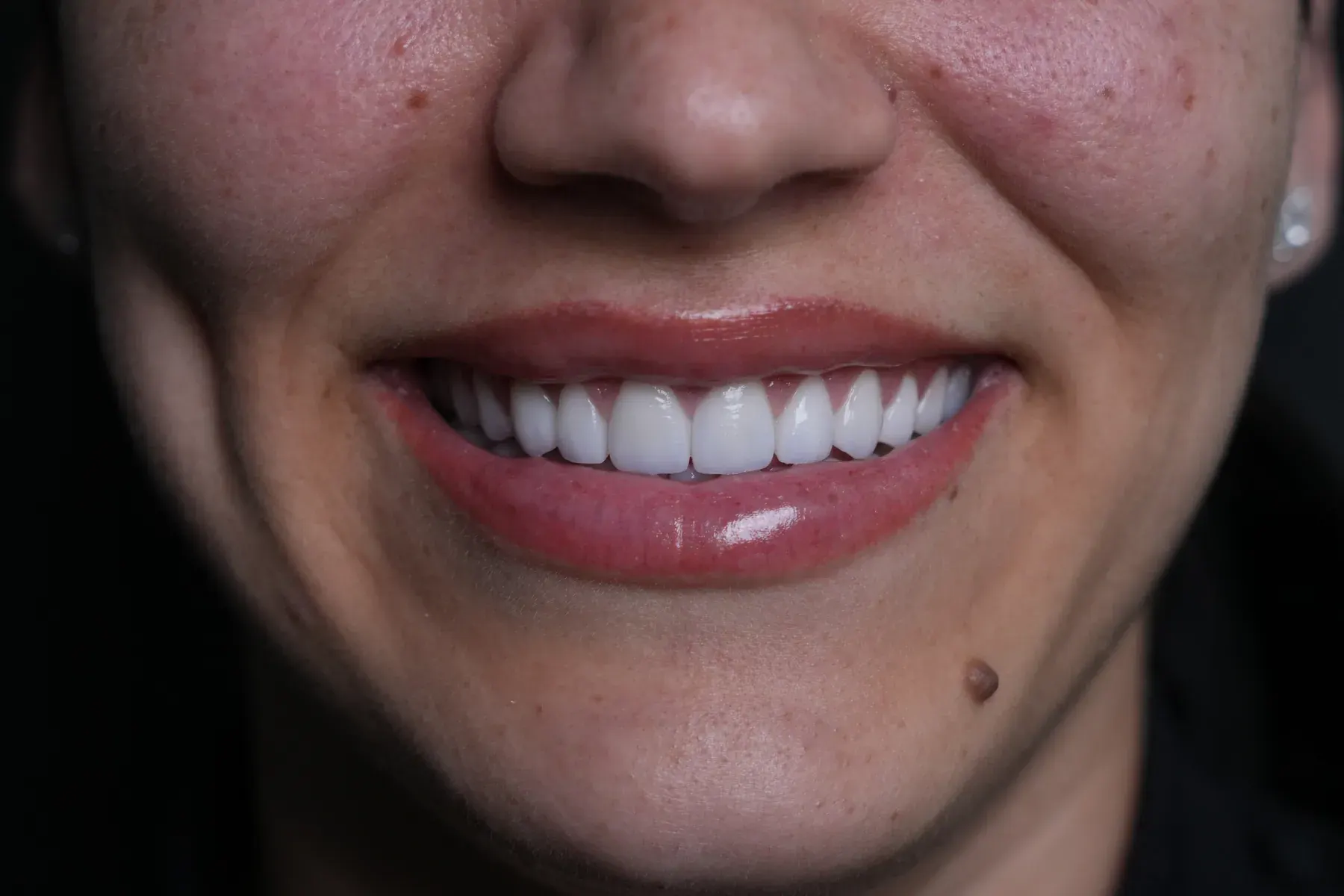
A veneer covers only the front of a healthy tooth to change its color, shape or size. A crown covers the whole tooth, all the way around, to protect one that is weak, broken, heavily filled or treated with a root canal. The real question is not which looks better, but how much healthy tooth you still have.
Two words in plain language
- Veneer: a thin shell, usually of porcelain, bonded to the front surface of a tooth. Think of it like a new face for the tooth. The back and the sides of your natural tooth stay as they are.
- Crown: a cap that covers the entire visible part of the tooth, like a thimble over a finger. It replaces the outer layer all the way around and holds the tooth together.
Both are made to match the teeth next to them, and both are fixed: you don't take them out.
The real difference: how much tooth is shaped
To fit a veneer, the dentist usually removes a very thin layer from the front of the tooth, often around the thickness of a fingernail or less, and sometimes almost nothing. To fit a crown, the tooth is shaped on every side so the cap can slide over it.
That is why dentists usually follow a simple rule: keep as much natural tooth as possible. If a veneer can do the job, it is generally the more conservative choice. If the tooth needs to be held together, a crown is the safer one.
Side by side
| Veneer | Crown | |
|---|---|---|
| What it covers | The front surface | The whole tooth, all around |
| How much tooth is shaped | Very little, sometimes almost none | More, on every side |
| Main job | Change how a tooth looks | Protect and rebuild a weak tooth |
| Usually best for | Stains, small chips, gaps, uneven shapes | Large fillings, cracks, broken teeth, after a root canal |
| Typical location | Front teeth, the ones you see when you smile | Front or back teeth |
When a veneer usually makes sense
A veneer tends to be the right call when the tooth underneath is strong and the problem is mostly about appearance:
- Stains that whitening does not lift, like some internal discoloration.
- Small chips or worn edges.
- Small gaps between front teeth.
- Teeth that look too short, too narrow or slightly uneven.
- A smile you want to redesign as a whole, from canine to canine or wider.
If you are still deciding between materials, our guide on porcelain vs composite veneers explains the options, and the porcelain veneers treatment page shows how we work.
When a crown usually makes sense
A crown is about strength first. Your dentist will often recommend one when:
- A large part of the tooth is a filling, so there is little natural enamel left to bond a veneer to.
- The tooth is cracked, and covering it all the way around helps keep the crack from spreading.
- A piece of the tooth broke off, especially on a back tooth that takes heavy chewing force.
- The tooth had a root canal (a treatment that cleans the inside of the tooth). Back teeth in particular tend to become more brittle afterwards, and a crown protects them.
- A dental implant needs a visible tooth on top of it.
The dental crowns page explains the process step by step.
Can you mix them in the same smile?
Yes, and it is common. Many smile makeovers combine veneers on healthy front teeth with a crown on a tooth that is weak or already restored. The key is that every piece is designed together so the color, translucency and shape match.
This is where having the lab inside the clinic helps. At Art Dental Studio, veneers and crowns are designed and hand-painted by master ceramist Enrique in our in-house dental lab, so a crown on one tooth and veneers on its neighbors can be shade-matched side by side instead of across a courier box.
How your dentist decides
It is a clinical decision, and it starts with an exam and X-rays. These are the things that weigh in:
- How much healthy enamel is left. Veneers bond best to enamel, the hard outer layer of the tooth.
- Size of existing fillings. Big old fillings change the answer.
- Cracks or fractures. Some are only on the surface; others go deeper.
- Your bite. If you clench or grind, the design and material may change.
- What you want to change. Color only? Shape? Both? Some cases need neither, and whitening or orthodontics is the better first step.
The honest answer is sometimes "neither": a chipped edge may only need bonding, and crowding may be better treated by moving the teeth. A good dentist will tell you that.
What about cost?
Cost depends on how many teeth are involved, the material, and whether the tooth needs other treatment first. We don't publish fixed numbers because no two cases are the same. Your consultation is free and you leave with a written estimate. You can also read about what affects the cost of veneers and the financing options available.
Questions to ask at your consultation
- Is my tooth strong enough for a veneer, or does it need a crown?
- How much of my tooth will be shaped for each option?
- If I mix veneers and crowns, how will you match the color?
- Will I see a preview of the result before the final pieces are made?
- How should I care for them, and what should I avoid biting?
The bottom line
Veneers change how a healthy tooth looks; crowns protect a tooth that needs strength. Neither is "better" in general — the right one depends on how much natural tooth you still have and what it needs to do. Ask your dentist to show you, on your own X-rays and photos, why they recommend one or the other.
Art Dental Studio offers complimentary consultations at three South Florida locations — Miami, Cooper City and Kendall — with bilingual care in English and Spanish. Every porcelain veneer is hand-crafted in-house by master ceramist Enrique, under the direction of Dr. Vivian Menendez (DMD · ADA · AACD · Invisalign Preferred Provider), and you see a digital preview of your new smile before anything is made.
Frequently asked questions
What is the main difference between a veneer and a crown?
A veneer covers only the front surface of a healthy tooth to change its color, shape or size. A crown covers the whole tooth, all the way around, to protect and rebuild a tooth that is weak, cracked, heavily filled or treated with a root canal.
Which one removes more of my natural tooth?
A crown usually requires shaping the tooth on every side so the cap can fit over it. A veneer usually needs only a very thin layer removed from the front, and sometimes almost none. That is why dentists prefer a veneer when the tooth is strong enough.
Can veneers and crowns be combined in the same smile?
Yes. Many smile makeovers use veneers on healthy front teeth and a crown on a tooth that needs more strength. The key is designing every piece together so color, translucency and shape match. An in-house lab makes that shade-matching easier.