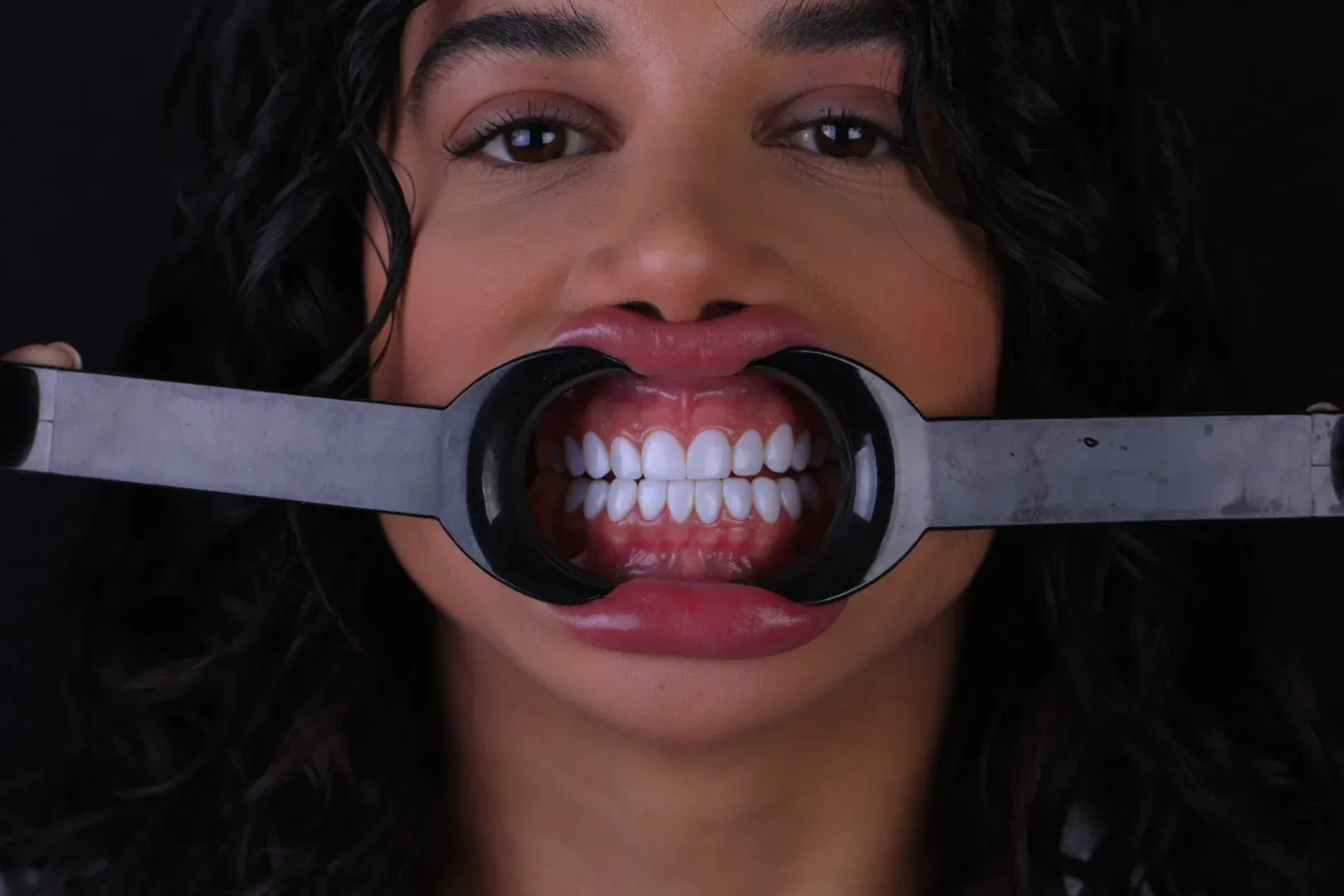
If you're missing most or all of your teeth, you have two main options: traditional removable dentures or All-on-4 implant-supported teeth. The choice between them is one of the most consequential dental decisions you'll make — affecting how you eat, speak, smile and feel about yourself every single day for the rest of your life. Here's the honest comparison.
The fundamental difference
Traditional dentures sit on your gums, held in place by suction (sometimes assisted by adhesive). You remove them at night and to clean them. They restore appearance and basic function, but bite force is significantly reduced, and most patients have at least some difficulty with hard or sticky foods long-term.
All-on-4 uses four dental implants per jaw to support a fixed, non-removable bridge of teeth. The teeth don't come out — you brush them like natural teeth. Bite force returns to near-natural levels. There's no adhesive, no slipping, no soaking at night.
The functional difference is enormous. Patients who switch from traditional dentures to All-on-4 consistently describe the change as "life-altering."
Side-by-side comparison
| All-on-4 (fixed) | Traditional Dentures (removable) | |
|---|---|---|
| Stays in place | Fixed — never removed | Removable — taken out at night |
| Adhesives | None needed | Often needed for stability |
| Preserves jawbone | Yes — the implants stimulate the bone | No — bone loss continues over time |
| Eating | Bite force close to natural teeth | Limited with hard or sticky foods |
| Feel and confidence | Feels like your own teeth | Can slip while eating or speaking |
| Lifespan | Implants 25+ yrs; bridge 10–15 yrs | Reline every 2–3 yrs, replace every 5–10 |
| Daily care | Brush and floss as taught | Remove and clean nightly |
The long-term value: durability and preserved bone
Here's the difference almost no one sees at first. When you lose your teeth, the bone that held them begins to resorb. Removable dentures rest on top of that bone but don't stimulate it — over the years the bone shrinks, the denture fits worse, and that's why it needs periodic relining and eventual replacement. All-on-4 does the opposite: the titanium implants act like artificial roots and keep the bone stimulated and preserved.
So rather than comparing two dentures, it's better to think about the result you'll live with every day for the next 10, 20 or 30 years — a solution that preserves the bone and functions like fixed teeth, day after day.
When traditional dentures are actually the right choice
Despite all of the above, traditional dentures remain the right answer for some patients:
- Insufficient bone for implants: Some patients have lost too much bone and bone grafting is contraindicated due to medical conditions
- Uncontrolled medical conditions: Severe diabetes, certain bisphosphonate medications, or compromised immune systems can rule out implant surgery
- Heavy smoking with no plans to quit: Smoking reduces implant success rates significantly
- Patient preference for removability: Some patients prefer being able to remove their teeth at night for personal or hygiene reasons
There's no shame in choosing traditional dentures — they restore function and appearance, and sometimes they're the right medical decision. The goal is to make an informed choice.
When All-on-4 is the clear winner
For patients who meet the medical criteria, All-on-4 is the better long-term choice for:
- Current denture wearers tired of removable teeth: this is the most common transition we perform
- Patients with multiple failing teeth needing extraction soon: avoid an intermediate solution you'd only have to replace
- Active lifestyle, eating out frequently, public speaking, professional roles: the confidence difference is significant
- Patients who value not having to think about their teeth: All-on-4 truly is "set it and forget it"
- Younger patients (under 60) facing 20+ years with dentures: durability strongly favors implants
What about the surgery?
All-on-4 surgery is performed under sedation (oral or IV). The procedure takes 2-4 hours per arch and you leave the same day with a temporary set of teeth. Most patients report mild to moderate discomfort for 3-7 days, easily managed with prescribed pain medication. By 1-2 weeks, most patients are back to normal activities.
Treatment duration varies depending on the specific needs of each patient. During your free consultation, we will evaluate your case and give you a personalized treatment plan with an accurate timeline. During this period you have temporary teeth that look and function nearly identical to the final result. You're never toothless.
A common middle path: implant-supported (snap-on) dentures
There's a third option worth knowing: snap-on dentures supported by 2-4 implants. They snap onto the implants for stability when worn, but can be removed for cleaning — more secure than a traditional denture, while still removable.
The trade-offs: better stability than traditional dentures but still removable; more bite force than a removable denture but less than All-on-4; simpler than full All-on-4, though you still deal with taking them out at night.
For some patients (especially those who like the ability to remove teeth at night) this is the perfect balance.
How to decide
At your free consultation at Art Dental Studio, we evaluate:
- Your jawbone density (3D imaging shows whether implants are feasible)
- Your overall health and medications
- Your lifestyle and what matters most to you
- Your timeline (do you need teeth in 2 weeks or a few months?)
We present all three options (traditional, snap-on, All-on-4) honestly and without pressure. If you'd like to spread out the treatment, financing options with monthly payments are available. Most patients take 1-2 weeks to think it over.
Patient outcomes
Patients we've transitioned from traditional dentures to All-on-4 consistently describe the change as life-changing — rediscovering foods they had given up, laughing without covering their mouths, and often wishing they had made the switch sooner.
The reverse — patients who chose traditional dentures and later regret it — is unfortunately common. It's why we present All-on-4 honestly as an option, even for patients who feel unsure at first.
Next step
If you're missing most or all of your teeth and weighing your options, a free consultation gets you real answers based on your specific situation. We'll do 3D imaging, evaluate your case, and walk you through every option transparently.
Frequently asked questions
Which lasts longer — All-on-4 or a traditional denture?
All-on-4 lasts considerably longer. The implants themselves typically last 25 years or more and the fixed arch 10 to 15, while a traditional denture needs periodic relining and eventual replacement — partly because it does nothing to stop the bone loss underneath it.
Does All-on-4 really preserve bone when dentures do not?
Yes. All-on-4 implants act as artificial roots and keep stimulating the jawbone, which helps preserve it. A traditional denture only rests on the gum, so the bone underneath keeps resorbing and the denture fits worse year after year.
When is a traditional denture the better choice?
When there is not enough bone for implants and grafting is ruled out, when uncontrolled medical conditions make surgery inadvisable, or when a patient simply prefers being able to take their teeth out at night. In those cases a denture is the right call, not a compromise.